Roofing Insurance Claims in Hawaii: A Step-by-Step Guide for Homeowners
· R&C Roofing Contractors

A storm damages your roof. You notice missing shingles, water stains on the ceiling, or debris scattered across your property. Now you're wondering whether your homeowners insurance will cover the repairs and what you should do first.
Filing a roofing insurance claim in Hawaii involves more than reporting damage. You need to understand your policy, document what happened, work with your insurance adjuster, and determine whether your roof needs repairs or replacement.
At R&C Roofing Contractors, we help Oahu homeowners understand the condition of their roofs and prepare contractor-side documentation for insurance claims. Our approach starts with inspecting the damage rather than assuming you need a new roof.
The important distinction: We inspect roofing damage, provide repair or replacement estimates, and answer technical questions about our findings. Your insurance company determines coverage and payment. We do not act as public adjusters or negotiate insurance settlements.
Here's how to approach the claims process and avoid decisions that could create unnecessary problems.
1. Check Your Insurance Coverage Before Filing a Claim
Not every damaged roof qualifies for insurance coverage. What matters is the cause of the damage, your policy's exclusions, and the type of coverage you purchased.
Homeowners insurance commonly covers certain sudden, accidental events. However, policies generally distinguish storm-related damage from deterioration that develops over time.
For Oahu homeowners, that distinction can be particularly important.
Storm damage versus normal roof deterioration
Hawaii roofs face conditions that can make damage difficult to evaluate without a closer inspection.
Examples include:
- Strong winds: Lifted shingles, damaged roof edges, displaced flashing, or compromised roof materials.
- Wind-driven rain: Water entering through an opening created or worsened during a storm.
- Falling branches or debris: Impact damage to roofing materials or underlying components.
- Coastal corrosion: Rust and deterioration around metal components, fasteners, and flashing.
- Long-term wear: Aging sealants, worn shingles, and deterioration caused by prolonged exposure.
Wind and debris damage may qualify for coverage depending on your policy. Ordinary wear, neglected maintenance, and corrosion are commonly excluded.
A leak appearing during a storm does not automatically mean the storm caused covered damage. An older flashing problem, for example, may have existed before the rain began.
Our roof inspections help identify visible damage patterns and distinguish potential storm impacts from deterioration. That information can help you understand the roofing problem before discussing coverage with your insurer.
Understand your deductible and roof valuation
Before deciding whether to file, review these policy details:
| Policy term | What it means for your roof claim |
|---|---|
| Standard deductible | The amount you pay toward a covered loss before insurance payment applies. |
| Hurricane deductible | A separate deductible that may apply to qualifying hurricane losses, often calculated as a percentage of insured dwelling value. |
| Actual Cash Value (ACV) | Replacement cost adjusted for depreciation, subject to policy terms. |
| Replacement Cost Value (RCV) | Coverage based on eligible replacement costs, potentially with depreciation withheld until qualifying repairs are completed. |
| Roof-age endorsement | A provision that may limit payment based on the roof's age or condition. |
For example, if your dwelling coverage is $600,000 and your applicable hurricane deductible is 2%, the deductible would be $12,000. At 5%, it would be $30,000.
That does not mean every wind-related claim triggers a hurricane deductible. The applicable deductible depends on the policy and circumstances of the loss.
Review your declarations page and endorsements, then ask your insurer which deductible applies.
The Hawaii Insurance Division provides consumer insurance information and regulatory resources.
2. How Long Do You Have to File a Roof Insurance Claim in Hawaii?
There is no single filing deadline that applies to every Hawaii homeowners insurance policy.
Your policy may require prompt notice of a loss. It may also contain separate deadlines for submitting documentation, providing proof of loss, or bringing legal action.
Look for the section titled Duties After Loss or similar wording.
If you discover damage weeks after a storm, don't assume you're automatically disqualified. Notify your insurer promptly after discovering it and explain when you first noticed the problem.
Keep a record of that communication.
You should also take reasonable steps to prevent additional damage when it is safe to do so. For example, temporary professional protection may help prevent water from entering through an exposed roof section.
Keep receipts for emergency work and ask your insurer about documentation requirements before authorizing extensive repairs.
3. How to File a Roof Insurance Claim in Hawaii
Following an organized process makes it easier to communicate with your insurer and compare the eventual insurance estimate with the roofing work needed.
Step 1: Make sure the property is safe
After severe weather, inspect the property from the ground.
Avoid climbing onto a wet or storm-damaged roof. Loose materials, compromised decking, and nearby electrical hazards can make an inspection dangerous.
If water is entering your home, protect belongings where you can safely do so. Contact an appropriate professional for temporary protection when needed.
Step 2: Document the damage
Take photographs before damaged materials are removed whenever it is safe.
Your documentation should include:
- Wide photographs showing the affected roof areas from safe viewpoints.
- Close-up photographs of visible damage where safely accessible.
- Interior ceiling stains, dripping water, or damaged finishes.
- Fallen branches or debris associated with the event.
- The date you discovered the damage and any relevant storm information.
If you need historical weather information, the National Weather Service Honolulu office is a useful starting point.
Weather records can help establish the conditions surrounding an event, but they do not independently prove that a particular roof sustained covered damage.
Step 3: Notify your insurance company
Use the claims phone number or online reporting system provided by your insurer.
Explain what you observed without guessing about hidden damage or the exact cause of a leak.
Ask for your claim number, the next steps, and any deadlines for submitting documents.
Follow up in writing when appropriate so you have a record of what was reported.
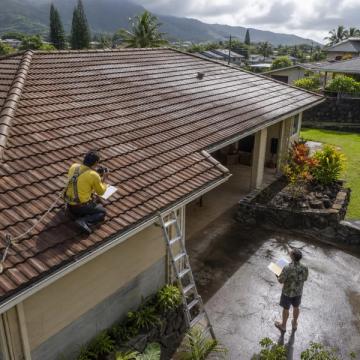
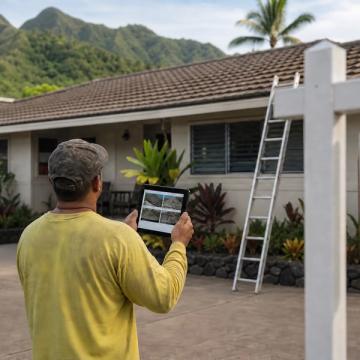
Step 4: Arrange a professional roof inspection
A roofing contractor can examine areas that are difficult or unsafe for a homeowner to evaluate.
At R&C Roofing, we offer free roof inspections and estimates. Our inspection findings can help identify whether the damage is localized or whether a broader roofing problem needs attention.
For insurance-related inspections, Robert Pilato holds HAAG roof inspection certification #201408313.
When a formal written inspection report is needed, we quote the additional fee before preparing it.
Step 5: Organize your claim documentation
Roof insurance claim documentation checklist
Photographs of roof and interior damage
Date of loss and damage discovery notes
Relevant weather information
Insurance policy and applicable endorsements
Claim number and insurer correspondence
Receipts for temporary protection or repairs
Contractor's inspection findings and repair estimate
0 of 7 items ready Copy checklist
Keep everything together in a digital folder or physical file. This will make it easier to answer questions and track changes during the claims process.
4. What Happens During the Insurance Adjuster's Inspection?
After you report the loss, your insurer may arrange an inspection by a staff or independent adjuster.
The adjuster evaluates the reported damage for the insurer. Their findings may influence the insurer's coverage decision and repair estimate.
If possible, be present during the inspection.
Show the adjuster the damage you documented and explain when you noticed it. Mention interior water damage, previous repairs, and any temporary work completed.
You can also ask whether your roofing contractor may attend to answer technical questions about the roof.
How our roofing documentation can help
Our role is to explain the physical condition of the roof and the work we believe is necessary.
Depending on the damage, we can provide:
- Photographs and documentation of observed roof conditions.
- A contractor's repair or replacement scope.
- Estimates prepared using Xactimate, software commonly used by insurance adjusters.
- Technical clarification about roofing materials and repair requirements.
Using familiar estimating software can make it easier to compare line items, but it does not determine what an insurer will approve.
The insurer and its adjusters handle claim evaluation. A licensed public adjuster may represent a policyholder in a claim dispute. We remain focused on roofing inspection, estimating, and approved construction work.
5. How to Review Your Roof Insurance Estimate
Once the insurer provides an estimate, compare it with the contractor's proposed scope.
A roof estimate should account for the actual work required, not simply the visible roofing material.
Depending on the roofing system and damage, relevant items may include:
| Estimate component | Why it matters |
|---|---|
| Roof covering | Replacing damaged shingles or other affected roofing materials. |
| Underlayment | Addressing protective layers when replacement is required. |
| Flashing | Repairing or replacing damaged metal details around penetrations and roof transitions. |
| Ridge and edge components | Restoring affected roof edges, caps, or starter materials. |
| Decking | Addressing damaged underlying sheathing when discovered and included in the approved scope. |
| Removal and disposal | Accounting for existing materials that must be removed. |
| Permits | Including applicable permitting requirements and associated costs. |
Not every item applies to every roof or every insurance claim.
If an estimate appears incomplete, identify the specific differences rather than assuming the insurer intentionally undervalued the work.
For example, an insurer's estimate might address damaged shingles but omit flashing that also sustained damage.
A contractor can document the condition of that flashing and prepare a corresponding repair estimate for your review and submission.
You can then ask the insurer to explain its estimate or consider additional documentation.
6. Will Insurance Pay for Roof Repair or Replacement?
A damaged roof does not automatically qualify for complete replacement.
The appropriate construction work depends on how much of the roof is damaged, the condition of surrounding materials, and whether a repair can reliably address the problem.
Insurance coverage is a separate question.
When a roof repair may be appropriate
A targeted repair may make sense when:
- Damage is confined to a limited area.
- Surrounding roofing materials remain serviceable.
- The damaged flashing or roof covering can be repaired without compromising nearby components.
- The underlying decking remains in suitable condition.
For example, a storm might damage several shingles while the remaining roof is in reasonable condition.
If the surrounding system can support a proper repair, replacing the entire roof may be unnecessary.
When replacement deserves consideration
Broader replacement may be appropriate when the inspection reveals widespread deterioration, extensive storm damage, compromised decking, or repeated failures that cannot be addressed effectively with localized repairs.
However, a contractor's recommendation for replacement does not mean the insurance company must pay for it.
The insurer evaluates the covered loss under the policy, while we explain the roofing work needed.
Hawaii building requirements may also affect the scope of a repair or replacement. Applicable requirements depend on the property, roof system, and proposed work.
Do not assume a commonly mentioned roofing "25% rule" automatically requires full replacement. Confirm any applicable code requirements with the relevant permitting authority.
For a closer look at the construction decision, see our roof repair services.
7. What If Your Roof Insurance Claim Is Denied or Underpaid?
A denial and an insufficient repair estimate are different problems.
A denial means the insurer has determined that some or all of the claimed loss is not covered. An underpayment concern may arise when the insurer accepts coverage but the approved amount or scope differs from the work your contractor believes is necessary.
The appropriate response depends on what is being disputed.
If your claim is denied
Request the insurer's explanation in writing, including the relevant policy provisions.
Determine whether the disagreement involves the cause of damage, an exclusion, a missed condition, or insufficient documentation.
If the insurer disputes the physical condition of the roof, additional inspection findings may help clarify the situation.
If the approved estimate is too low
Compare the insurer's estimate against the contractor's scope.
Identify specific differences, such as missing flashing work or quantities that do not reflect the documented damage.
Ask your insurer how to submit additional evidence or request a reinspection.
For disputes involving the amount of loss, some policies contain appraisal provisions. These provisions have specific requirements and may not resolve disputes about whether damage is covered.
A licensed public adjuster or attorney can help you understand options involving policy interpretation or claim disputes.
You can also contact the Hawaii Insurance Division about insurer-related concerns.
Our role is narrower. We can re-inspect the roof, review the carrier's technical notes, and provide additional contractor-side findings for you to submit.
For more information, see our denied or underpaid roof claims resource.
8. Common Mistakes That Can Complicate a Roof Insurance Claim
Some insurance claim problems arise from avoidable decisions made before the damage is fully documented.
Waiting too long to report damage
Delays can make it harder to establish when the problem occurred. Report suspected damage according to your policy requirements and keep records.
Making extensive repairs before documenting the roof
Emergency protection may be necessary, but replacing damaged materials before documenting them can remove useful evidence. Ask your insurer about inspection requirements before proceeding with non-emergency work.
Assuming every leak is storm damage
A leak may result from an older installation problem, worn flashing, or storm-related damage. Identifying the cause matters when discussing coverage.
Accepting an estimate without reviewing the scope
An insurance estimate may differ from a contractor's estimate. Understand the reason for any differences before approving construction.
Hiring a contractor who promises insurance approval
Roofing contractors cannot guarantee coverage decisions. Be cautious of anyone promising a particular settlement or offering to conceal your deductible.
Before hiring, verify the contractor's license through the Hawaii Department of Commerce and Consumer Affairs.
9. How We Help Oahu Homeowners With Storm-Damaged Roofs
Our work begins with the physical condition of your roof.
We serve homeowners across Oahu, including Honolulu and surrounding communities. We evaluate the roofing system and explain whether the findings support a repair or a broader replacement.
Our relevant services include:
- Roof inspections: We assess visible roof conditions and explain the damage we find.
- Storm and wind damage assessments: We examine roofing materials, flashing, and other affected components for observable damage patterns.
- Insurance claim documentation: We prepare photographs, technical findings, and contractor estimates. We use Xactimate for estimating.
- Roof repairs: We address localized roofing problems when the surrounding roof remains serviceable.
- Roof replacement: When a larger project is necessary, we explain the proposed construction scope and provide an estimate.
Our Hawaii contractor license is CT-33642.
Rob, our HAAG Certified roof inspector, brings specialized damage-assessment training to inspections involving storm impacts and roofing deterioration. Chris and Rob share our inspection-first approach: determine what the roof actually needs before recommending major work.
We offer free inspections and estimates. If you need a formal written report for your insurance records, we explain the additional fee before preparing it.
10. Get Clear Answers About Your Roof Before Moving Forward
If your roof has been damaged by wind, falling debris, or heavy rain, the first useful step is understanding what happened and what work is necessary.
You do not need to assume that every leak requires replacement, or that every storm-related roofing problem will be covered by insurance.
We can inspect your roof, explain our findings, and prepare a contractor estimate if work is needed. You remain responsible for filing your claim, and your insurance company makes the coverage and payment decisions.
Contact R&C Roofing Contractors to request a free roof inspection and estimate.
Written inspection reports are available for an additional fee quoted in advance.
You can also call us at (808) 888-2524.
Mahalo for considering R&C Roofing Contractors.