Gutter Installation in Honolulu: Costs, Materials, and What to Expect
· R&C Roofing Contractors
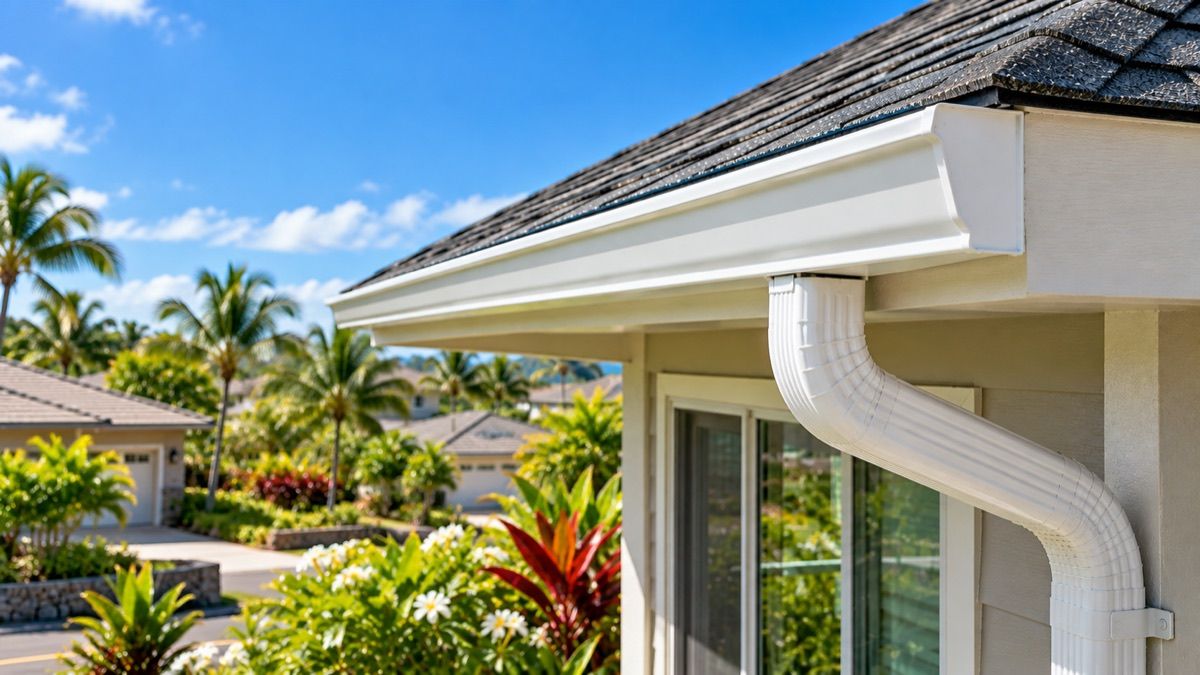
A gutter system does more than collect rainwater. It directs runoff away from your roof edges, exterior walls, and foundation. When gutters are undersized, poorly installed, or damaged, water can end up where it should not.
For homeowners in Honolulu and across Oahu, choosing the right gutter installation service means considering more than the price per linear foot. Heavy rainfall, coastal exposure, roof design, and the condition of your fascia can all influence which system makes sense.
At R&C Roofing Contractors, we look at how gutters work with the surrounding roofing system. A new gutter will not solve a drainage problem if damaged flashing or deteriorated roof edges are allowing water behind it.
This guide explains what gutter installation may cost, how materials compare, when repairs are sufficient, and what to ask before hiring a contractor.
How Much Does Gutter Installation Cost in Honolulu?
Gutter installation costs depend on the material, total footage, roofline complexity, and work required before the new system can be installed.
National pricing guides provide a starting point, but they should not be treated as Honolulu-specific estimates.
Estimated gutter installation costs by material
The following approximate national ranges are from the original pricing comparison. They are useful for preliminary budgeting, but current supplier pricing and local installation costs must be confirmed.
| Gutter material | Approximate installed cost per linear foot |
|---|---|
| Vinyl | 3-8 |
| Seamless aluminum | 6-12 |
| Galvanized or painted steel | 8-15 |
| Copper | 20-40+ |
For example, a home requiring 200 linear feet of seamless aluminum gutters could have a preliminary national-range estimate of 1,200 - 2,400.
That calculation does not necessarily include removing existing gutters, replacing damaged components, additional downspouts, or other site-specific work.
Honolulu homeowners should expect local quotes to differ from national averages. Shipping requirements, labor availability, material specifications, and access conditions can affect the final price.
Rather than relying on a general cost calculator, request an itemized estimate based on your actual roofline.
What increases the cost of gutter installation?
Several factors can make two similar-sized homes receive very different estimates.
Roof height and accessibility
Installing gutters on a single-story home is generally more straightforward than working along a tall or difficult-to-access roofline. Steep slopes and limited working space may require additional equipment or safety measures.
Roofline complexity
Corners, changes in elevation, and multiple roof sections increase the number of fittings and installation details. A complicated roofline may require more labor even if the total gutter footage is relatively modest.
Downspout requirements
Downspouts must accommodate runoff from the roof areas they serve. Additional downspouts or larger components may be necessary when water is concentrated in particular sections.
Existing gutter removal and roof-edge condition
Removing old gutters adds labor and disposal costs. If the fascia is deteriorated or the roof edge needs attention, those conditions should be addressed before the new gutters are installed.
Gutter guards and accessories
Debris guards, specialized outlets, and other accessories can increase the project cost. Whether they are worthwhile depends on nearby vegetation and maintenance needs.
When comparing estimates, check whether each contractor has included the same work. A lower quote may simply exclude items that another contractor has accounted for.
Seamless vs. Sectional Gutters: Which Is Better for Hawaii?
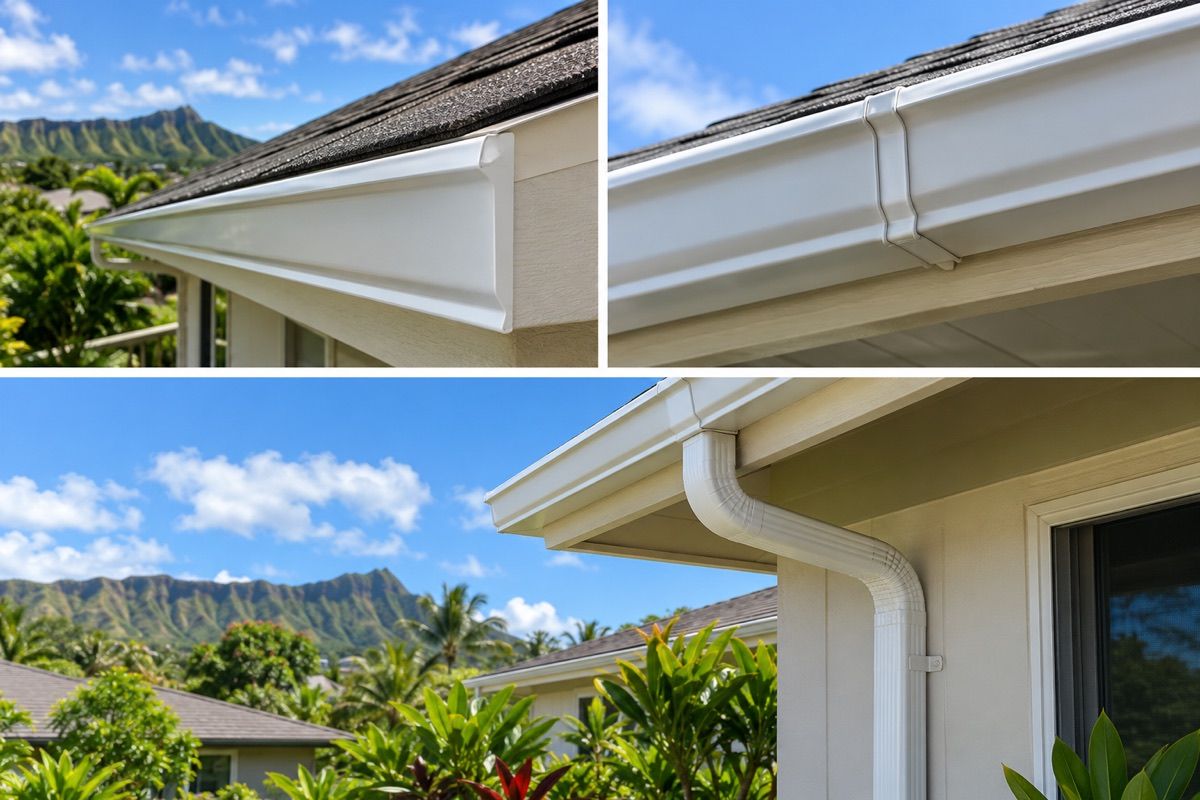
Seamless gutters
Continuous runs with joints mainly at corners and outlets.
Sectional gutters
Shorter sections connected with additional joints.
Seamless and sectional gutters perform the same basic job, but their construction differs.
Seamless gutters are typically formed to the required length, reducing the number of joints along straight runs. Corners, end caps, and outlets still require connections and proper sealing.
Sectional gutters are assembled from shorter pieces. They can be easier to transport and replace individually, but the additional joints create more locations where seals may eventually need maintenance.
For many Oahu homes, seamless gutters are worth considering because fewer joints can reduce potential leakage points.
However, seamless construction does not eliminate the need for proper installation. Incorrect slope, inadequate fastening, or poorly positioned downspouts can cause problems regardless of the gutter type.
The condition of the roof edge matters just as much as the gutter construction.
Choosing Gutter Materials for Honolulu's Climate
Hawaii's climate introduces considerations that may be less significant in some mainland locations.
Salt exposure can accelerate corrosion of susceptible metals. Strong sunlight affects certain plastics and finishes, while wind-driven rain can expose weaknesses in gutter joints and roof-edge details.
Different materials respond to these conditions differently.
Aluminum gutters
Aluminum is a common residential choice because it is lightweight and does not develop the red rust associated with steel.
It can still experience corrosion, particularly in environments with significant salt exposure or where incompatible metals create galvanic corrosion.
For coastal homes, ask about the material's finish, compatible fasteners, and manufacturer recommendations for marine exposure.
Steel gutters
Steel gutters offer strength but require appropriate protective finishes to resist corrosion.
Scratched coatings, exposed cut edges, and deteriorating connections may become vulnerable to rust.
If considering steel near the coast, compare its maintenance requirements and protective coating specifications against other options.
Vinyl gutters
Vinyl gutters are often considered because of their lower initial cost.
However, thermal movement and prolonged UV exposure can affect some vinyl products. Installation must accommodate expansion and contraction, and the material's suitability depends on the specific product.
Copper gutters
Copper is generally a higher-cost option valued for its appearance and corrosion resistance.
It develops a patina as it weathers. Proper detailing and compatible metals are important because runoff from copper can contribute to corrosion or staining of certain adjacent materials.
Copper may be worth considering for particular architectural designs, but the higher material and installation costs should be weighed against the home's needs.
Which material should you choose?
For many residential projects, aluminum is a reasonable starting point for comparison. That does not make it automatically suitable for every property.
Before selecting a system, consider the home's distance from the ocean, roof material, drainage requirements, maintenance expectations, and budget.
The gutter material should also be compatible with the existing roof-edge components.
Why Gutter Size and Downspout Placement Matter
A gutter can be correctly attached and still overflow if it cannot handle the water reaching it.
Residential gutters commonly come in 5-inch and 6-inch sizes, but choosing between them requires more than measuring the house.
The appropriate size depends on the roof area draining into each section, roof pitch, local rainfall intensity, and the capacity of the downspouts.
A large roof section draining toward one short gutter run can create a concentrated flow. Valleys can also direct substantial amounts of water into a relatively small area.
Rainfall conditions vary across Oahu
A home in a windward community may experience different rainfall patterns from a property on the leeward side. Even within Honolulu, site conditions and surrounding terrain influence exposure.
The Rainfall Atlas of Hawaiʻi is a useful resource for understanding local rainfall patterns. However, average annual rainfall alone does not determine gutter sizing. Short-duration rainfall intensity is especially important when evaluating drainage capacity.
If gutters repeatedly overflow during heavy rain, the cause may be insufficient capacity, blocked outlets, poor slope, or a combination of problems.
Simply installing a larger gutter without checking the downspouts may not correct the issue.
When Should You Repair Gutters Instead of Replacing Them?
Not every leaking or overflowing gutter needs complete replacement.
We recommend identifying the source of the problem before deciding how much work is necessary.
Problems that may be repairable
A targeted repair may be appropriate when the surrounding gutter system remains in serviceable condition.
Examples include:
- A loose hanger that can be securely reattached to sound fascia
- A leaking joint or end cap that can be properly resealed
- A localized section of damage
- A blocked downspout causing water to back up
- A minor alignment problem that can be corrected without rebuilding the system
A gutter that overflows only during certain storms may need a drainage-capacity evaluation rather than immediate replacement.
Signs replacement may be the better option
More extensive work may be justified when deterioration affects multiple sections or the system cannot reliably direct water away from the building.
Look for gutters pulling away from the fascia, widespread corrosion, repeated joint failures, or significant sagging.
Water stains behind gutters are particularly important. They may indicate that runoff is getting between the gutter and fascia rather than flowing into the gutter.
Peeling paint, soft wood, or deteriorated soffits can also suggest prolonged moisture exposure.
These symptoms do not automatically mean the entire roof needs replacement. They do mean the roof edge deserves closer inspection.
Our approach is to evaluate the condition first. If a localized repair can address the problem while the surrounding system remains sound, we would rather explain that option than recommend unnecessary replacement.
Why the Roof Edge Should Be Inspected Before Installation
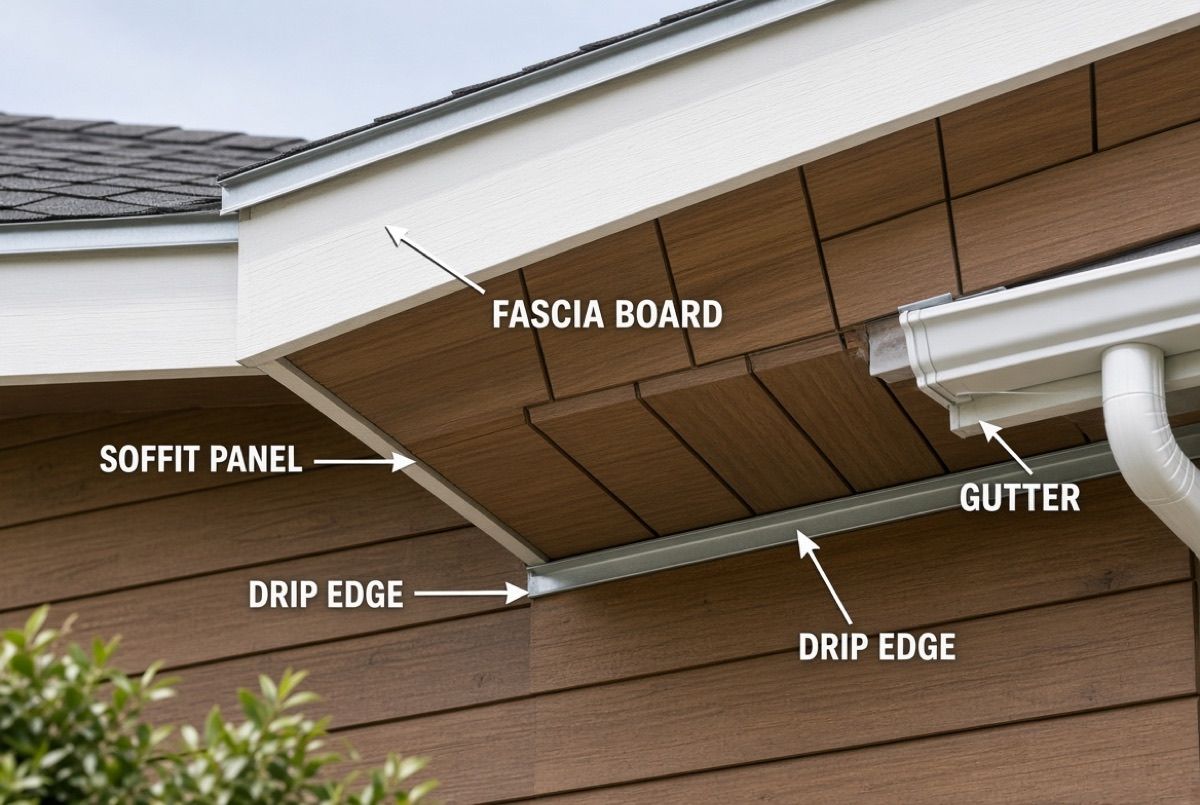
Gutters attach near one of the roof's most vulnerable areas: the eave.
This is where runoff leaves the roofing surface and enters the drainage system. If the transition is poorly detailed, water can travel behind the gutter and wet the fascia or soffit.
Several components deserve attention before installation.
Fascia condition: Gutters need a suitable, secure attachment surface. Fasteners driven into deteriorated wood may not hold properly.
Drip edge and flashing: Roof-edge details should guide water into the gutter rather than allowing it to reach exposed wood or the wall assembly.
Roof covering: Damaged shingles, deteriorated underlayment near the edge, or previous repairs can affect how water drains.
Existing drainage: Downspouts need appropriate outlets. Water should not be directed toward locations where it can accumulate against the building.
If your home is also due for a new roof, coordinating gutter work with roof replacement and installation services can help avoid unnecessary removal or interference with newly installed components.
This coordination is particularly useful when existing roof-edge materials need replacement.
What to Expect During Professional Gutter Installation
The exact installation process depends on the building and selected system, but homeowners should expect the contractor to explain the work before installation begins.
A typical project involves several stages.
1. Inspection and measurement
The contractor measures the roofline, identifies drainage areas, evaluates access, and checks the condition of the existing gutter attachments.
This is also the time to discuss recurring overflow, leaks, or water accumulation around the property.
2. Material and drainage planning
The contractor determines the gutter profile, size, material, downspout locations, and fastening method.
Ask why the proposed system is appropriate for your roof rather than accepting a particular size simply because it is standard.
3. Removal and preparation
If existing gutters are being replaced, they are removed and the attachment areas are examined.
Any damaged substrate or related roof-edge work should be identified before new gutters conceal those areas.
4. Gutter installation
The gutters are installed with an appropriate slope toward their outlets.
Hangers and fasteners should follow the selected system's requirements and account for site conditions. Exact spacing depends on the product, attachment substrate, and applicable specifications.
5. Drainage checks and cleanup
The completed system should be checked for secure attachment, proper water flow, and obvious leakage at joints or outlets.
Downspout discharge locations should also be reviewed.
Before approving the work, ask how any drainage concerns identified during installation were resolved.
Installation time varies with building height, roofline complexity, weather, access, and the amount of preparation required. Request a project-specific schedule rather than assuming the work will take one day.
Can a Handyman Install Gutters in Hawaii?
Hawaii regulates contractor licensing, and homeowners should verify whether the person performing gutter installation is appropriately licensed for the proposed scope.
Hawaii Revised Statutes Chapter 444 contains limited exemptions for certain small projects. The applicable rules depend on factors including total project value and whether a building permit is required.
A homeowner should not assume that gutter installation is exempt simply because the work appears straightforward.
The Hawaii Department of Commerce and Consumer Affairs provides contractor licensing information, and the Hawaii Legislature provides access to applicable statutes.
For larger or more involved projects, verify the contractor's license status and classification before signing an agreement.
What about big-box installation services?
Some retailers arrange installation through third-party providers.
If considering that option, confirm that gutter installation is available at your Hawaii location and identify the contractor who will actually perform the work.
Ask who is responsible for evaluating roof-edge conditions, addressing unexpected damage, and responding to installation concerns.
The important comparison is not simply whether the contractor is independent or retailer-affiliated. It is whether the proposed scope is appropriate and the responsibilities are clear.
How to Compare Gutter Installation Quotes
A useful estimate should tell you what you are buying and what work is excluded.
Before choosing a gutter installation company, compare these details:
| What to check | Why it matters |
|---|---|
| Total linear footage | Confirms the quantity being priced |
| Material and finish | Affects corrosion resistance and maintenance |
| Gutter size and profile | Helps determine suitability for the roof |
| Downspout quantity and locations | Influences drainage performance |
| Fasteners and hangers | Affects attachment and durability |
| Removal and disposal | Prevents unexpected additional charges |
| Roof-edge or fascia work | Clarifies whether existing damage is included |
| Warranty terms | Establishes what the contractor or manufacturer covers |
| Schedule and exclusions | Helps avoid misunderstandings |
Ask whether the estimate includes checking the existing drip edge and flashing.
Also find out how the contractor handles concealed damage discovered after old gutters are removed. Ideally, additional work should be documented and approved before it proceeds.
For permitting questions, consult the City and County of Honolulu Department of Planning and Permitting. Requirements can depend on the scope of the work, particularly when gutters are part of a larger roofing project.
Finally, verify licensing information through the appropriate Hawaii state records rather than relying only on an advertisement.
Gutter Installation and Related Roofing Services From R&C Roofing
We provide gutter work alongside roof inspections and roofing services for homeowners and property owners across Oahu.
Our relevant services include:
- Gutter Installation & Repair: New installations, targeted repairs, complete gutter replacement, and gutter work coordinated with reroofing.
- Roof Inspections: We assess the condition of the roofing system, including relevant drainage and roof-edge concerns, before recommending work.
- Roof Repair: When an issue involves deteriorated flashing or a localized roofing defect, we evaluate whether a targeted repair is appropriate.
- Roof Replacement & New Installation: For roofs with more extensive deterioration, we can assess the roofing assembly and coordinate related gutter requirements.
You can explore our roofing and gutter services to learn more about the work we provide.
R&C Roofing Contractors holds Hawaii contractor license CT-33642, with C-42 roofing and C-5 carpentry classifications. Robert Pilato is our HAAG Certified roof inspector, certification #201408313.
Our inspection-first approach means we assess the existing condition before recommending whether repair or replacement makes sense.
How to Maintain Your Gutters After Installation
Even a properly installed gutter system needs periodic attention.
Leaves, branches, seed pods, and other debris can restrict water flow. Nearby trees may increase the frequency of cleaning required.
Inspect gutters from a safe location, particularly after heavy winds or storms. Look for visible sagging, vegetation growing in the gutter, staining beneath joints, and water spilling over the edges.
If accessible from the ground, observe where downspouts discharge during rain. Water should be directed to an appropriate drainage location rather than collecting against the building.
Avoid climbing onto a roof or working from an unsafe ladder to clear debris. Difficult-to-access gutters should be handled by someone equipped to work safely at height.
Gutter guards can reduce the amount of certain debris entering a system, but they do not eliminate inspection or maintenance. Their effectiveness depends on the type of debris and guard design.
Get a Gutter Installation Estimate in Honolulu
The right gutter system depends on your roof's drainage needs, the condition of its edges, and the environment around your property.
If your gutters are leaking, pulling away, or overflowing, we can help assess whether a repair or replacement is appropriate.
We offer free roof inspections and estimates. If you need a formal written inspection report, we explain the additional fee before proceeding.
Contact R&C Roofing Contractors to discuss gutter installation or repair for your Oahu property, or call (808) 888-2524.